
If you didn’t know, the pancreas has two full-time jobs. While GLP-1s are hired for one, they operate inside both. So what does the pancreas actually do, what changes when an incretin drug like a common prescribed GLP-1 is on board, and where do bioregulators sit in all of this? Let’s find out.
By the Promethean Bioregulators Team | Published September 2026
The Pancreas: One Gland, Two Jobs
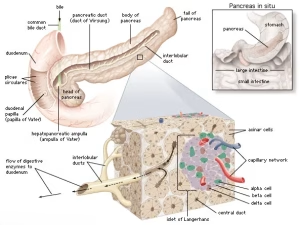 Most people think of the pancreas as the insulin organ. While true, insulin is the smaller half of what it does.
Roughly four-fifths of the gland is exocrine tissue: clusters of acinar cells that manufacture proteases, lipase and amylase and send them down the pancreatic duct into the duodenum.12 That juice is how a plate of food becomes amino acids and fatty acids your body can use. Without it, protein passes through you.
The endocrine pancreas is the other job, and it is physically scattered through the first one. Islets of Langerhans hold beta cells that make insulin, alpha cells that make glucagon, and smaller populations that secrete somatostatin and pancreatic polypeptide.2
Two systems, one blood supply, one duct, one organ. That anatomy is the reason this article exists, because a drug hired to talk to one half is unavoidably operating inside the other.
Introducing the GLP-1 Receptor Agonist
 Glucagon-like peptide-1 (GLP-1) is an incretin hormone the gut releases after a meal. It was isolated from pig intestinal mucosa in 1987 and shown to increase insulin secretion from perfused pancreas.3 Native GLP-1 is short-lived. It amplifies glucose-dependent insulin release, restrains glucagon, slows gastric emptying and reduces food intake.45
Prescription agonists are engineered to last. They occupy the same receptor for days rather than minutes, and at therapeutic doses they act on the brain to cut appetite and on the stomach to delay emptying.6
The scale of the effect is why the class left the diabetes clinic. In STEP 1, once-weekly semaglutide 2.4 mg plus lifestyle intervention produced a mean weight change of −14.9% at 68 weeks against −2.4% on placebo.7 Dual GIP/GLP-1 agonists have gone further.
Note the mechanism carefully, because it matters for everything below: the drug does not supply insulin. It asks beta cells to release more of their own, in response to glucose, for longer than a meal would ask on its own.
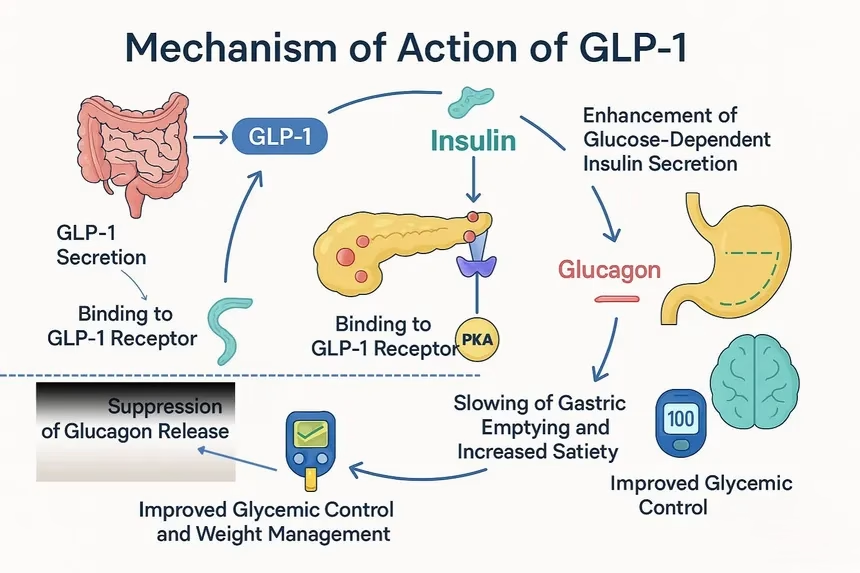
Three Things Change in Pancreatic Work
The islets answer a longer signal
Glucose-dependent insulin secretion is the point of the therapeutic. The cells doing the secreting are the same beta cells that were there before the prescription. In a gland that where the user is often in midlife, has extra adiposity, and / or has some degree of insulin resistance, these cells were already working against a headwind.
Food arrives on a different schedule
Delayed gastric emptying is part of the glycemic benefit.4 But it also changes when chyme, bile and pancreatic juice meet each other. The exocrine side is not being asked to do less work; it is being asked to do it on an altered timetable, in fewer and smaller sittings.
The meals that protect muscle are the ones that need enzymes
Body-composition data here is mixed. A 2024 review found lean-mass reductions running between 40% and 60% of total weight lost in some trials, and approximately 15% or less in others, with the heterogeneity traceable to population, drug and comorbidity differences.8 The same review concluded that MRI-based measurement suggests the muscle changes are largely adaptive. It was proportionate to the weight lost and the person’s age, and accompanied by improved insulin sensitivity and reduced muscle fat infiltration.89
As such, any one on these GLP-1s are advised to eat protein at each meal sitting in adequate quantities, as well as do resistance training two or three days a week. Protein you cannot digest is protein you did not eat.
The GLP-1 Safety Record
Understanding what the current studies show is important. It can instruct how you supplement other aspects of your health.
✅ Pancreatitis. Early observational signals put pancreatitis on labels. A 2025 meta-analysis of 62 randomized trials covering 66,232 patients found an increased risk overall (RR 1.44, 95% CI 1.09–1.89), which lost statistical significance once trials were stratified by background medication use.10
❌Pancreatitis – Take Two. A separate meta-analysis of nine tirzepatide trials found no significant pancreatitis association.11
❌ Pancreatic cancer. The same 2025 analysis found no overall association (RR 1.30, 95% CI 0.86–1.97), but did find a significant increase in the subgroup taking background medications (RR 1.85, 95% CI 1.05–3.26). The authors note this difference is likely minimal given how many zero-event trials were excluded.10
✅ Gallbladder and biliary. This is the clearer signal. Cholelithiasis incidence was higher with both subcutaneous and oral semaglutide than placebo across the SUSTAIN and PIONEER programmes.12 The tirzepatide meta-analysis found the composite of gallbladder or biliary disease significantly associated with treatment (RR 1.97, 95% CI 1.14–3.42), though not the individual components.11
❓Gastroparesis. A 2026 systematic review located twelve case reports describing thirteen patients. Onset ranged from hours to months, commonly after dose escalation. Discontinuation resolved symptoms in every reported case.13 Thirteen cases cannot establish a rate; the authors describe it as under-recognized rather than rare.
❌ Exocrine insufficiency. One 2024 case report: a 68-year-old man on weekly semaglutide for 181 weeks, with repeated asymptomatic lipase elevations and ongoing alcohol consumption, later diagnosed with exocrine pancreatic insufficiency.14 A single case with a plausible co-factor is an anecdote, not a rate.
In short, gastrointestinal effects are common and usually settle. More serious side effects, cancers, don’t seem to present. What is important, always talk with your physician before taking any medication.
Pancreas Bioregulators
 The Pancreas Bioregulator is a peptide complex extracted from pancreatic tissue and taken as a capsule. Also known as Suprefort or Peptide Complex A-1, these peptides are very short. At only two to four amino acids in length, it separates them from therapeutics, hormone therapy, enzyme replacement and every injectable peptide currently in circulation
The proposed mechanism is epigenetic rather than hormonal. These molecules are small enough to enter the cell nucleus, and the research describes them as signals that influence how existing genes are read, not as ligands that occupy a receptor and trigger a response.15 A GLP-1 agonist works by binding a receptor. A bioregulator is proposed to work upstream of that, on the tissue’s own protein synthesis. The model comes largely from one research tradition and needs more independent replication.
Two names appear in the literature and they are not the same thing. Suprefort is the natural peptide complex, and it is what the Promethean capsule contains. Pancragen is a synthetic tetrapeptide, Lys-Glu-Asp-Trp, built from the active sequence found in those extracts, and it is what almost all of the indexed experimental work actually tested. Research on the synthetic peptide informs the category.
The Pancreas Bioregulator Research Summarized
- Cell cultures. In human pancreatic cell cultures, differentiation markers fell with ageing, and Pancragen raised differentiation factors for both acinar cells (Pdx1, Ptf1a) and islet cells (Pdx1, Pax6, Pax4, Foxa2, Nkx2.2).16 In aged human pancreatic cultures the same tetrapeptide raised markers of functional activity and proliferation (MMP2, MMP9, Mcl-1, PCNA, Ki-67) and lowered pro-apoptotic p53.17 The effect was tissue-specific: Pancragen moved pancreatic differentiation factors, a bronchial peptide moved bronchial ones, a vascular peptide moved fibroblast ones.18
- Primates. In old rhesus monkeys, Pancragen at 50 µg per animal per day intramuscularly for ten days increased the rate of glucose disappearance and normalised insulin and C-peptide curves, with part of the effect still present three weeks after withdrawal.19 Compared against glimepiride in nine old female rhesus monkeys (five on the peptide, four on the drug) both lowered basal glucose; Pancragen normalized insulin and C-peptide, while the sulfonylurea produced a stronger delayed glucose drop and stimulated C-peptide without a clear insulin-secretion effect.20
- Rodents. In streptozotocin-diabetic rats, oral pancragen produced a hypoglycemic effect during treatment.21
- People. In 33 older adults with type 2 diabetes and 30 healthy controls, nocturnal melatonin production was around 70% lower in the diabetes group. Pancragen lowered fasting and post-load glucose, plasma insulin and an insulin-resistance index.22 In twelve elderly people with impaired glucose tolerance, Pancragen-forte at 500 µg twice daily for four weeks was followed, in half the group, by significantly lower plasma glucose on an oral glucose tolerance test.23
Two Together Create Complementary Support
| GLP-1 medicine | Pancreas Bioregulator | |
|---|---|---|
| What it is | Long-acting receptor agonist | Peptide complex from pancreatic tissue |
| Acts on | GLP-1 receptor (plus GIP for tirzepatide) | No hormone receptor |
| Job | Meal-time insulin, glucagon, emptying, appetite | Digestive health, healthy glucose balance |
| Contains insulin or enzymes | No | No |
| Timeframe | Appetite in days; weight and A1C over months | Cumulative; judge a full course |
| Regulated as | Prescription drug | Dietary supplement |
| Pricing | Prescription, varies based on dosage, insurance and use | $61.00 for 20 capsules |
 Used together, the arithmetic is simple. The prescription does what it was designed to do. The Pancreas Bioregulator is a 20-day course of organ-specific peptide support alongside it.
Thinking about your overall health, a well-balanced diet, exercise and appropriate supplementation may optimize pancreatic wellness while on GLP-1s. You can learn more about digestive grouping and start with our Digestive Health Kickstart Plan.
Also read our article on insulin resistance. It covers the pineal and liver peptides.
References
- Talathi SS, Zimmerman R, Young M. Anatomy, abdomen and pelvis, pancreas. In: StatPearls. Treasure Island, FL: StatPearls Publishing; updated 2025. NCBI Bookshelf NBK532912
- Atkinson MA, Campbell-Thompson M, Kusmartseva I, Kaestner KH. Organisation of the human pancreas in health and in diabetes. Diabetologia. 2020;63(10):1966-1973. PMC7565096
- Holst JJ, Ørskov C, Nielsen OV, Schwartz TW. Truncated glucagon-like peptide I, an insulin-releasing hormone from the distal gut. FEBS Lett. 1987;211(2):169-174. PubMed 3542566
- Drucker DJ. Mechanisms of action and therapeutic application of glucagon-like peptide-1. Cell Metab. 2018;27(4):740-756. PubMed 29617641
- Müller TD, Finan B, Bloom SR, et al. Glucagon-like peptide 1 (GLP-1). Mol Metab. 2019;30:72-130. PMC6812410
- Drucker DJ. GLP-1 physiology informs the pharmacotherapy of obesity. Mol Metab. 2022;57:101351. PMC8859548
- Wilding JPH, Batterham RL, Calanna S, et al. Once-weekly semaglutide in adults with overweight or obesity. N Engl J Med. 2021;384(11):989-1002. PubMed 33567185
- Neeland IJ, Linge J, Birkenfeld AL. Changes in lean body mass with glucagon-like peptide-1-based therapies and mitigation strategies. Diabetes Obes Metab. 2024;26(Suppl 4):16-27. PubMed 38937282
- Chrysavgis L, Mourelatou NG, Koloutsou ME, Rozani S, Cholongitas E. The influence of glucagon-like peptide-1 receptor agonists and other incretin hormone agonists on body composition. Int J Mol Sci. 2025;26(24):12130. PMC12733374
- Wen J, Nadora D, Bernstein E, et al. Evaluating the rates of pancreatitis and pancreatic cancer among GLP-1 receptor agonists: a systematic review and meta-analysis of randomised controlled trials. Endocrinol Diabetes Metab. 2025;8(5):e70113. PMC12457091
- Zeng Q, Xu J, Mu X, Shi Y, Fan H, Li S. Safety issues of tirzepatide (pancreatitis and gallbladder or biliary disease) in type 2 diabetes and obesity: a systematic review and meta-analysis. Front Endocrinol (Lausanne). 2023;14:1214334. PMC10613702. Corrigendum: Front Endocrinol. 2024;15:1342543. PMC10976973
- Aroda VR, Erhan U, Jelnes P, et al. Safety and tolerability of semaglutide across the SUSTAIN and PIONEER phase IIIa clinical trial programmes. Diabetes Obes Metab. 2023;25(5):1385-1397. PubMed 36700417
- Olubodun T, Osundina MA, Soyoye DO, et al. Gastroparesis induced by glucagon-like peptide-1 receptor agonists: a systematic review of clinical features, diagnosis, management, and outcomes. PLoS One. 2026;21(8):e0354497. PMC13472420
- Agra de Melo Junior C, Gomes Júnior NE, da Silva Ribeiro-Sousa MA, Cunha SFC. Exocrine pancreatic insufficiency during the use of semaglutide: a case report. Cureus. 2024;16(3):e55549. PMC10993639
- Khavinson VK, Lin’kova NS, Tarnovskaya SI. Short peptides regulate gene expression. Bull Exp Biol Med. 2016;162(2):288-292. PubMed 27909961
- Khavinson VKh, Durnova AO, Polyakova VO, et al. Effects of pancragen on the differentiation of pancreatic cells during their ageing. Bull Exp Biol Med. 2013;154(4):501-504. PubMed 23486591
- Khavinson VKh, Sevost’ianova NN, Durnova AO, et al. Tetrapeptide stimulates functional activity of the pancreatic cells in aging. Adv Gerontol. 2012;25(4):680-684. PubMed 23734516
- Khavinson VKh, Linkova NS, Polyakova VO, Kheifets OV, Tarnovskaya SI, Kvetnoy IM. Peptides tissue-specifically stimulate cell differentiation during their aging. Bull Exp Biol Med. 2012;153(1):148-151. PubMed 22808515
- Goncharova ND, Ivanova LG, Oganyan TE, Vengerin AA, Khavinson VKh. Impact of tetrapeptide pancragen on endocrine function of the pancreas in old monkeys. Adv Gerontol. 2014;27(4):662-667. PubMed 25946840
- Goncharova ND, Ivanova LG, Oganyan TE, Vengerin AA, Khavinson VK. Correction of impaired glucose tolerance using tetrapeptide (Pancragen) in old female rhesus monkeys. Adv Gerontol. 2015;28(3):579-585. PubMed 28509500
- Khavinson VKh, Gavrisheva NA, Malinin VV, Chefu SG, Trofimov EL. Effect of pancragen on blood glucose level, capillary permeability and adhesion in rats with experimental diabetes mellitus. Bull Exp Biol Med. 2007;144(4):559-562. PubMed 18642713
- Korkushko OV, Khavinson VKh, Shatilo VB, Antonyk-Sheglova IA, Bondarenko EV. Prospects of using pancragen for correction of metabolic disorders in elderly people. Bull Exp Biol Med. 2011;151(4):454-456. PubMed 22448364
- Korkushko OV, Chizhova VP, Shatilo VB, Khavinson VKh. The tetrapeptide pankragen forte efficiency in elderly people with prediabetic state. Adv Gerontol. 2013;26(2):297-308. PubMed 28976155