
Your pancreas gets most of the attention when blood sugar starts climbing. But your liver deserves some of it too. Many people don’t realize the liver stores glucose, makes glucose and also processes fat. However, when fat accumulates inside it, those jobs can become harder to coordinate. So how does “fatty liver” connect to insulin resistance, what actually improves it, and where do liver bioregulators fit? Let’s explore.
By the Promethean Bioregulators Team | Published September 2026
Insulin Resistance: Two Organs Are Involved
Between meals, your liver helps keep glucose available by breaking down stored glycogen and manufacturing new glucose. After eating, insulin helps tell it to reduce that output. Incoming food and the liver’s own production have to be coordinated.
With hepatic insulin resistance, that instruction becomes less effective. The liver can continue releasing glucose when insulin should be asking it to slow down.1
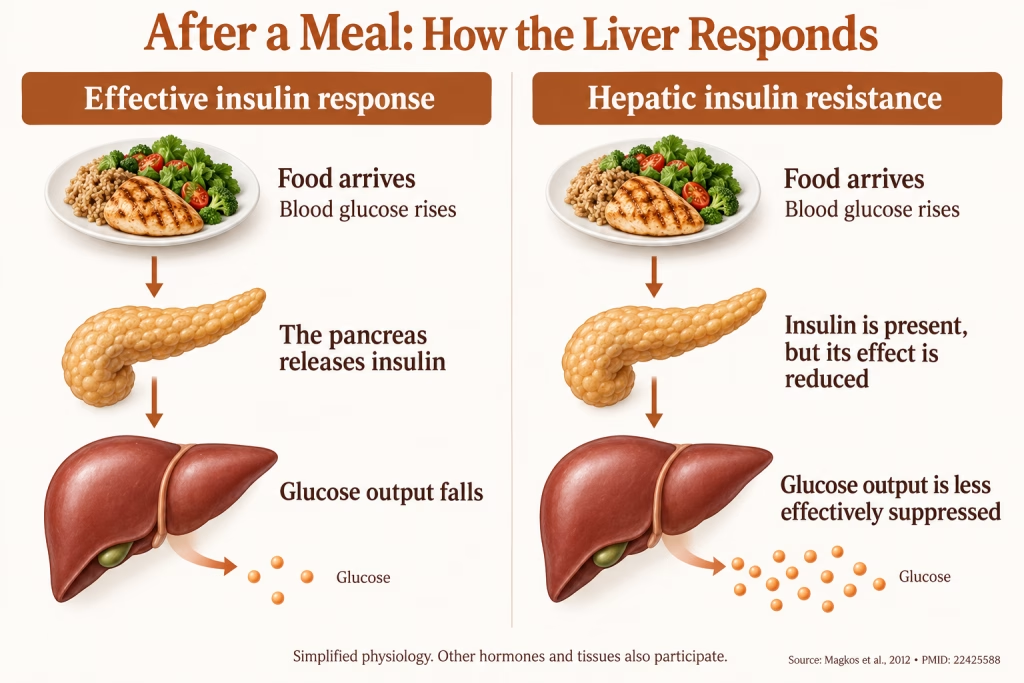
In other words, insulin helps suppress liver glucose production after eating, and hepatic insulin resistance weakens that response. And yes, there are other hormones and tissues that participate.1
A 2012 study examined this relationship in 16 adults with obesity. Researchers measured liver lipid compounds and used an insulin-clamp technique to assess how effectively insulin suppressed glucose production. Higher concentrations of diacylglycerol, a particular fat intermediate, were associated with poorer suppression.1
It was only a small study, and probably doesn’t establish the whole mechanism, but it helps explain why liver fat and blood sugar belong in the same conversation.
If you want more information on insulin resistance, check out our article that covers it.
“Fatty Liver.” New Name, Same Problems
Two different terms describe the same thing. Up until recently, nonalcoholic fatty liver disease or NAFLD was used in the literature. In 2023, an international consensus introduced MASLD or metabolic dysfunction-associated steatotic liver disease to the world. The goal was to put metabolic dysfunction into the name and diagnostic criteria.2
As you move down the severity chart, metabolic dysfunction-associated steatohepatitis or MASH is a chronic, progressive liver disease characterized by liver inflammation and damage caused by a buildup of excess fat in the liver.
| Term | What it describes |
|---|---|
| Metabolic Dysfunction-associated Steatotic Liver Disease (MASLD) | Fat accumulation in the liver with at least one cardiometabolic risk factor, after assessing other causes and alcohol exposure. |
| Metabolic Dysfunction-associated Steatohepatitis (MASH) | The inflammatory form, involving liver-cell injury. Older research calls this NASH. |
| Fibrosis | Scar tissue in the liver. Finding liver fat does not automatically mean advanced scarring. |
These terms describe different features of the disease. You’ll still see NAFLD and NASH in the references below, because those were the names used when the studies were published.2
So Where Does Liver Fat Come From?
In 2005, Donnelly and colleagues used stable-isotope tracers in nine patients with fatty liver to track the origins of fatty acids stored in liver triglycerides. The largest contribution came from circulating fatty acids; the liver’s manufacture of new fat also contributed substantially.3
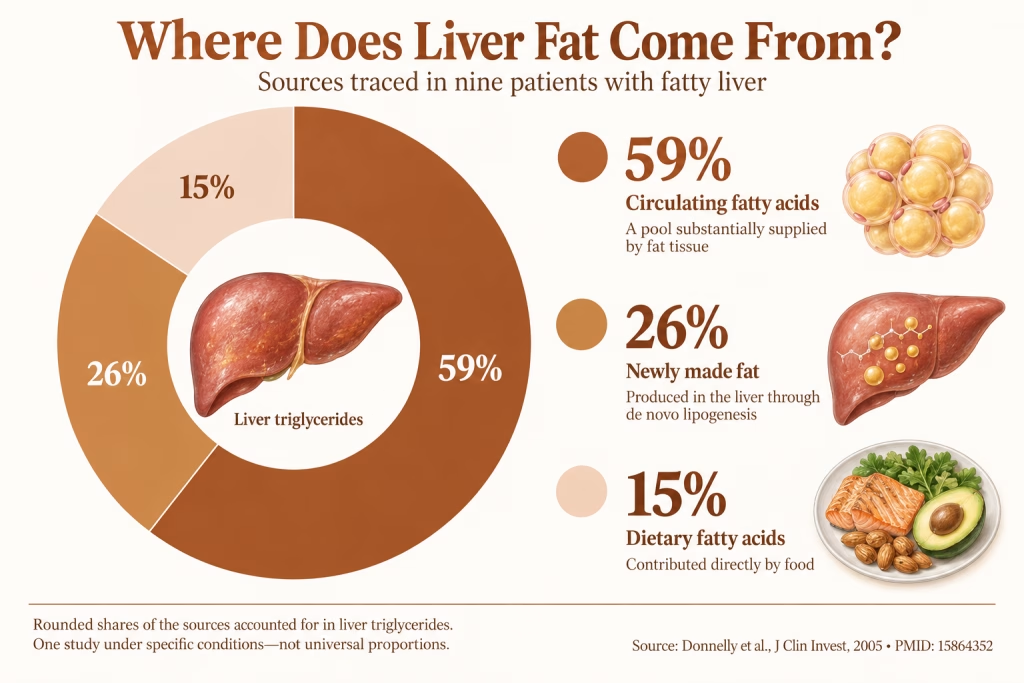
These are rounded proportions of the sources and are not universal proportions.3
The useful finding is that fat arrived from several directions, including the body’s own stores and its production of new fat. That makes fatty liver a broader metabolic problem than the fat content of your last meal.
Normal Bloodwork Doesn’t Mean a Normal Liver
A liver blood test, also known as a liver function test (LFT) measures the levels of enzymes, proteins, and waste products in the blood to assess how well the liver is working. These tests help detect liver damage, inflammation, or disease, and are commonly used to screen for conditions like hepatitis, monitor liver disease progression, and check for side effects from medications.
The most common components of a liver panel include liver enzymes: Alanine transaminase (ALT) and aspartate aminotransferase (AST). When liver cells are inflamed or damaged, they leak into the blood. The higher the numbers, the more attention they get.
They shouldn’t always. In a study of 515 people whose fatty liver had been confirmed by biopsy, 107 of them, about one in five, had ALT and AST sitting in the normal range. Advanced scarring showed up just as often in that group as in the people whose enzymes were high. 4
These were people already sent for a biopsy, so they aren’t a cross-section of everyone with normal labs. But it’s the reason doctors don’t stop at enzymes. A FIB-4 score combines those same two enzymes with your age and platelet count to estimate scarring risk. If that comes back concerning, a scan called elastography measures how stiff the liver has become.5
So You Have Fatty Liver… What Do You Do?
Sustain Weight Loss
Vilar-Gomez and colleagues followed 293 people with biopsy-proven NASH through 52 weeks of lifestyle changes; paired liver biopsies were available for 261 participants. Across the full group, 25% achieved resolution of steatohepatitis. Among those who lost at least 10% of their body weight, 90% had resolution and 45% had fibrosis regression.6
Although the study was observational, its findings suggest that sustained weight management may improve liver health.

Exercise
In a controlled study, 11 adults completed eight weeks of resistance exercise while eight continued usual care. The exercise group had a 13% relative reduction in liver fat, alongside improvements in glucose control and an insulin-resistance measure. Even though body weight did not significantly change, liver fat decreased significantly.7
Liver fat decreased from approximately 14.0% to 12.2%.
 Medication
 Medication
In the 966-patient primary analysis of MAESTRO-NASH, resmetirom, an oral thyroid hormone receptor-beta agonist, improved both NASH resolution and fibrosis outcomes compared with placebo at 52 weeks.8
Wegovy (semaglutide) injection received accelerated approval for a defined adult MASH population with moderate-to-advanced fibrosis. The FDA’s assessment describes a planned interim analysis at week 72 covering 800 trial participants, 534 on semaglutide and 266 on placebo, in which 63% of treated participants had MASH resolution without worsening of scarring, against 34% on placebo. The trial continues to 240 weeks to establish whether those changes translate into fewer serious liver events.9
If you have fatty liver, speak with your doctor about which options may work for you. If you want to read more on how GLP-1s affect insulin secretion and pancreatic function, read our GLP-1 and pancreas article.
Where Bioregulators Enter the Discussion
 The research question behind liver bioregulators concerns the cells themselves: can short peptides influence the processes that maintain liver tissue?
Our Liver Bioregulator, also known as Svetinorm or Peptide Complex A-7, is a naturally derived oral supplement marketed for liver wellness.
There’s some literature that supports this. Livagen is a synthetic tetrapeptide with the sequence Lys-Glu-Asp-Ala, built by directed chemical synthesis from amino-acid analysis of liver polypeptide preparations.10 It is the peptide almost all of the indexed experimental work actually tested. Mass spectrometry on Peptide Complex A-7 identifies Livagen and closely related sequences within the complex. It is work on a peptide family the analysis finds in the bottle.
The Research at a Glance
| What was tested | What researchers observed | What it points to |
|---|---|---|
| Rat liver cells, 2001 | Livagen increased protein synthesis in cultured hepatocytes, with the largest effect in cells from older animals.10 | Protein synthesis is the process the capsule is intended to support, and the effect was largest in cells from older animals. |
| Rat tissue cultures, 2001 | Livagen stimulated liver explant growth, while other short peptides acted on corresponding brain or thymus tissues.11 | Tissue selectivity. The liver peptide acted on liver, while other short peptides acted on their own tissues. |
| Rat liver tissue culture, 2002 | Researchers reported changes consistent with preservation of tissue structure and increased regenerative activity.12 | Structural preservation and regenerative activity, in liver tissue specifically. |
| Cultured human lymphocytes, 2002 | Livagen altered chromatin organization and activated ribosomal genes in cells obtained from older people.13 | A proposed route of action: short peptides reaching the nucleus and changing which genes are accessible. |
Two themes stand out: protein synthesis and tissue-specific activity. These are directly relevant to the idea of supporting cellular maintenance. The chromatin findings add another layer, since chromatin is the DNA-and-protein material inside the nucleus and its organization helps determine which genes are accessible.
The findings give researchers something concrete to investigate.
Putting It All Together
They’re called supplements for a reason. Bioregulators are intended to complement existing strategies. Here, we’ve focused on the Liver Bioregulator and the research behind it.
Our proposed protocol combines several bioregulators to address different aspects of metabolic health. Our Insulin Protocol Stack puts four together:
- Pancreas Bioregulator (Suprefort or Peptide Complex A-1): Supports pancreatic function, potentially aiding in glucose regulation and insulin production.
- Pineal Bioregulator (Endoluten or Peptide Complex A-8): May help regulate hormonal rhythms, including those affecting metabolism.
- Thymus Bioregulator (Vladonix or Peptide Complex A-6): By bolstering immune function, it may address the low-grade inflammation linked to insulin resistance
- Liver Bioregulator (Svetinorm or Peptide Complex A-7)
Read more about our insulin resistance protocol.
Putting Liver Health Into Your Plan
If fatty liver has appeared on a scan or in a conversation with your doctor, start by understanding the finding. Ask what may be driving it, whether fibrosis assessment is appropriate, and which measures will be used to follow progress.
Build the plan around sustainable nutrition, appropriate physical activity and management of metabolic risk. Review alcohol intake and your complete medication and supplement list with your clinician.5
If you are considering a liver bioregulator, bring the product label into that conversation so it sits in the same plan as everything else you are doing, and follow the same markers your clinician is already tracking.
References
- Magkos F, Su X, Bradley D, et al. Intrahepatic diacylglycerol content is associated with hepatic insulin resistance in obese subjects. Gastroenterology. 2012;142(7):1444-1446.e2. PubMed 22425588
- Rinella ME, Lazarus JV, Ratziu V, et al. A multisociety Delphi consensus statement on new fatty liver disease nomenclature. J Hepatol. 2023;79(6):1542-1556. PubMed 37364790
- Donnelly KL, Smith CI, Schwarzenberg SJ, Jessurun J, Boldt MD, Parks EJ. Sources of fatty acids stored in liver and secreted via lipoproteins in patients with nonalcoholic fatty liver disease. J Clin Invest. 2005;115(5):1343-1351. PubMed 15864352 | PMC1087172
- Ulasoglu C, Enc FY, Kaya E, Yilmaz Y. Characterization of patients with biopsy-proven non-alcoholic fatty liver disease and normal aminotransferase levels. J Gastrointestin Liver Dis. 2019;28(4):427-431. PubMed 31826068
- Rinella ME, Neuschwander-Tetri BA, Siddiqui MS, et al. AASLD Practice Guidance on the clinical assessment and management of nonalcoholic fatty liver disease. Hepatology. 2023;77(5):1797-1835. PMC10735173
- Vilar-Gomez E, Martinez-Perez Y, Calzadilla-Bertot L, et al. Weight loss through lifestyle modification significantly reduces features of nonalcoholic steatohepatitis. Gastroenterology. 2015;149(2):367-378.e5. PubMed 25865049
- Hallsworth K, Fattakhova G, Hollingsworth KG, et al. Resistance exercise reduces liver fat and its mediators in non-alcoholic fatty liver disease independent of weight loss. Gut. 2011;60(9):1278-1283. PMC3152868
- Harrison SA, Bedossa P, Guy CD, et al. A phase 3, randomized, controlled trial of resmetirom in NASH with liver fibrosis. N Engl J Med. 2024;390(6):497-509. PubMed 38324483
- U.S. Food and Drug Administration. FDA approves treatment for serious liver disease known as ‘MASH’. August 15, 2025. FDA announcement. Trial publication: Sanyal AJ, Newsome PN, Kliers I, et al. Phase 3 trial of semaglutide in metabolic dysfunction-associated steatohepatitis. N Engl J Med. 2025;392(21):2089-2099. PubMed 40305708
- Brodskiĭ VIa, Khavinson VKh, Zolotarev IuA, et al. Rhythm of protein synthesis in cultures of hepatocytes from rats of different ages. Norm and effect of the peptide livagen. Izv Akad Nauk Ser Biol. 2001;(5):517-521. Russian-language article. PubMed 15926314
- Khavinson VK. Tissue-specific effects of peptides. Bull Exp Biol Med. 2001;132(2):807-808. PubMed 11713572
- Riadnova IIu, Filippov SV, Iuzhakov VV. Functional morphology of an organotypic liver culture exposed to the peptide livagen. Adv Gerontol. 2002;10:88-94. Russian-language article; English abstract. PubMed 12577697
- Khavinson VKh, Lezhava TA, Monaselidze JG, et al. Effects of Livagen peptide on chromatin activation in lymphocytes from old people. Bull Exp Biol Med. 2002;134(4):389-392. PubMed 12533768
